Miles to go...

I have miles to go... please pray each day for the next leg of my Biblical journey!
Showing posts with label King David. Show all posts

Wednesday, August 29, 2012

Days 29 & 30: The Know-It-All


1 Chronicles 21:1-4

New Living Translation (NLT)
David orders a census.
V. Gilbert and Arlisle F. Beers

David Takes a Census

21 Satan rose up against Israel and caused David to take a census of the people of Israel. 2 So David said to Joab and the commanders of the army, “Take a census of all the people of Israel—from Beersheba in the south to Dan in the north—and bring me a report so I may know how many there are.”
3 But Joab replied, “May the Lordincrease the number of his people a hundred times over! But why, my lord the king, do you want to do this? Are they not all your servants? Why must you cause Israel to sin?”
4 But the king insisted that they take the census, so Joab traveled throughout all Israel to count the people. Then he returned to Jerusalem

***

Before I start, let me apologize for my absence the last several days. I made an unexpected trip out of town to attend the funeral of my last remaining uncle. While we grieve here on earth, heaven is rejoicing, and Uncle Frank is finally at peace, surrounded by the glory of God. So to catch up, I'm reading in double time and posting in half-time!

Many times I've read about David's census, and never really understood what the big deal was. At one point in time, God had wanted a census done of the Israelites. But when David decided it was a good idea, God didn't agree, and got really mad about it! Why?

King David was a devout man of God, no doubt. But no matter how much he loved the Lord, he was still human, and he still made a lot of mistakes. I like David, because his life is such a portrait of all true Christians; we can never be good enough. We can love the Lord with all our hearts, serve Him single-mindedly, but we're still not going to be perfect, we're still going to sin, we're still going to beg forgiveness, and we're still going to learn that even when God grants forgiveness, He doesn't exempt us from consequences.

So what was David's sin, here? Well, to start with, it wasn't entirely his sin. David's sin reflected the sin of israel, who had become a little too big for their britches, thinking they deserved to have a king they could see with their own eyes instead of allowing God to be their King. They'd lost their focus, and had let pride get in the way of better judgment. So in 2 Samuel 24:1, scripture says 
"And again the anger of the LORD was kindled against Israel, and he moved David against them to say, Go, number Israel and Judah."
So there ya have it. David was human, and God used his sin as a vessel to bring about His discipline on a sinful nation. And He accomplished this by allowing Satan to rise up and goad him into doing something stupid. And being the fallible human being that he was, David fell for it.

This census was never God's will. It was David's. He was king of the hill and he was feeling pretty good about it. He didn't want the census taken for God's glory, he wanted the census taken for his own! He had thirty warriors that made up the membership of an elite "club", the best of the best, and even more exclusive than that were his "three muskateers", the mighty warriors who commanded the thirty. But as awesome as that group was in battle, David knew that he ruled over way more than that, and he wanted bragging rights. So he told Joab and the other commanders to go find out how many warriors he had.

Joab was a little wiser than David this time around. He knew this was going to be bad, and even tried to warn him. He told David God would grow his army even a hundred times bigger, if he'd just give God the honor instead of letting the numbers go to his head. But David didn't listen, and he sent them out to count. 

The numbers came back, but only partially. Joab failed to count the tribes of Levi and Benjamin. So he gave David an incomplete count to try to keep his already inflated ego in check. The numbers were still impressive though. Over a million swordsmen in Israel, and  half as many again in Judah alone. And David was apparently pleased with himself over how strong his armies were.

God, on the other hand, was anything but pleased. Through Gad, David's seer, God gave him three options to choose from as punishment for his pride. He could choose three years of famine, or three months of slaughter at the hands of his enemies, or three days of plague as an angel of the Lord brought devastation to the land. 

Not being able to read God's mind and know exactly what that meant, I think I would have gone with door number three, just like David did. And just like me, I don't think David really understood that three days wasn't going to be a slap on the wrist! During those three days, 70,000 people died in Israel, and then God sent an angel to destroy the city of Jerusalem. As the angel stood next to the threshing floor of a Jebusite named Araunah (because the angel had to stand somewhere!), sword raised and ready to strike, God relented and said "Ok, that's enough, for now!". The angel didn't lower his sword though. He was ready should further action be required. 

Araunah looked up from where he was threshing wheat, and saw what was going on in the spiritual realm. I wonder if he took it in stride, or if he stood there gawking in fear and awe.  We know it scared the daylights out of his four sons though, because scripture says they ran away and hid. Their daddy didn't, though. Whatever he was thinking at the sight of this great, big, huge warrior-angel  standing over his threshing floor weilding a sword, his reaction isn't noted until David approached, humbled and dressed in burlap, and asked to purchase the threshing floor to build an altar to God so He would stop the plague. Araunah bowed before the king and offered to give him not only the floor, but the oxen to sacrifice as well. David was starting to smarten up though. He told the man he could not take what cost him nothing to make amends with God, and insisted on paying for it. The transaction cost 600 pieces of gold.

Ya know, I can't count the times I've heard believers quip "i'm not perfect, just forgiven". Nor can I count, sadly, how many times I've heard believers say that because we are forgiven, we're exempt from consequences. What a total misunderstanding of God's nature! He's a loving God, yes. He's a forgiving God, yes. But above all, He is a just God. We don't get a free pass when we screw up, and God's discipline is often a bitter pill. It's pretty important that we realize that our lesson isn't learned until we've accepted the discipline, humbled ourselves, and made things right with our Father.

That's it for Sunday and Monday. I'll have to combine blog entries for two days at a time for a few days while I catch back up. In the meantime, I hope you got something out of this. And if you didn't, well, I did.

Tuesday, August 14, 2012

Day 24: Three Men & A Girl


1 Kings 2:13-17

New Living Translation (NLT)
© Jorge Royan / http://www.royan.com.ar / CC-BY-SA-3.0

Solomon Establishes His Rule

13 One day Adonijah, whose mother was Haggith, came to see Bathsheba, Solomon’s mother. “Have you come with peaceful intentions?” she asked him.
“Yes,” he said, “I come in peace. 14 In fact, I have a favor to ask of you.”
“What is it?” she asked.
15 He replied, “As you know, the kingdom was rightfully mine; all Israel wanted me to be the next king. But the tables were turned, and the kingdom went to my brother instead; for that is the way the Lord wanted it. 16 So now I have just one favor to ask of you. Please don’t turn me down.”
“What is it?” she asked.
17 He replied, “Speak to King Solomon on my behalf, for I know he will do anything you request. Ask him to let me marry Abishag, the girl from Shunem.”

I've mentioned my fascination with the women in scripture. Abishag seems to be a bit of a mystery. I've spent a couple of hours trying to research her, and it seems that everybody has an opinion pertaining to her. It is believed by most that she is the woman whom the Songs of Solomon is written about, and when I get to that book, I'll probably assume that perspective.

But for the sake of this story, we'll just stick to the facts at hand, and try not to inject too much of the many theories I've read. King David was really old, and so frail that no amount of blankets could keep the man warm. Thinking that the attentions of a young woman might warm him up, his most trusted servants went on the hunt for a beautiful virgin. They found Abishag, a Shunammite girl who was very beautiful. Jewish history sources say that she was a rare beauty, and compare her loveliness to that of Sarah, Abraham's wife.

She was brought to the king to serve as his personal attendant both in and out of bed, and although it is presumed that she did sleep in his bed, scripture is very clear that they were never intimate... which meant that she was still a virgin and still available for David's successor to take as a wife. That would be the only person who would have a rightful claim to her, because  being regarded as one of David's closest servants, only another king would be allowed to make use of her in any capacity.

The time was coming when David would need to abdicate the thrown, but he'd been dragging his heels about it. He had promised to appoint Solomon, his son with Bathsheba, and as far as I know that was probably common knowledge around town. But there was an older brother, who according to birthright, should have been next in line to be king, since he was the oldest living son. Like his brother Absalom, he figured he'd have to find some other way to get there, because he knew his dad wasn't going to just hand him the keys to the kingdom. He figured he'd get away with it though, because the Bible says that David had never disciplined him at all.

And like his brother, Adonijah used his wit and charm to gain popularity and get a whole lot of people on his side, including many of those who had served David in trusted positions during his entire reign. People like Joab, and Abiathar, who helped him conspire to take over. So he threw himself a party, and declared himself king.

Meanwhile, David still had many of his best buds firmly in his camp, and one of them, Nathan the prophet, went to Bathsheba to discuss how they could get David to relinquish the throne. It would have to be done quickly. So Bathsheba went to David and had a little talk with him that went something like this.

Bathsheba: "Hey honey, remember when you promised that our boy, Solomon, would take over the family business when you got too old to run it?

David: "Yes, I remember"

Bathsheba: "Well you'd better make good on your promise quick, because that spoiled kid you had with Haggith is throwing himself a coronation party as we speak. He's made sacrifices already, and he's invited everyone to attend... Everyone, that is, except for you, me, Solomon, Zadok or Benaiah."

About that time, Nathan comes in and interrupts...

Nathan: My lord, are you aware of what your kid is doing? He's down there partying and sacrificing animals with Joab and Abiathar, and a whole slew of other people, and they're all hailing him as the new king! You never did keep that boy in line, but you sure need to do something now!"

So David assured Bathsheba he would make good on his promise that day, and arranged for it to happen. He sent Solomon to Gihon Spring riding the kings own personal steed (the Bible refers to it as David's mule, but I've always imagined a beautiful Arabian horse.) Zadok the priest, Nathan the prophet, and Benaiah the bodyguard went with him there and annointed him with olive oil. They blew the ram's horn, they shouted "long live the king" (King Solomon, that is), and then escorted him back to the palace where he took his place in daddy's chair. A long procession followed him back, playing flutes, shouting for joy, and making so much ruckus that the whole earth shook... and Adonijah and his little party heard the noise.

This not only scared Adonijah, it scared all those who were with him, too... like Joab and Abiathar. They all went slinking back to their homes, except for Adonijah, who went into the temple and grabbed hold of the horns of the altar, begging for his life. Solomon told him to go home, that he wouldn't kill him for what had happened earlier that day.

But Adonijah still had a card up his sleeve. He'd have been luckier if he'd had an ace, but all he had was a queen... kinda. He went to Bathsheba, and asked her to intercede on his behalf with her son, the newly crowned King. The scriptures make it sound like she was pretty indifferent to him, so I'll relate it that way.

Adonijah: "Hey there, Bathsheba. Can I talk to you a sec?"

Bathsheba: "Depends on whether you're trying to start trouble or not."

Adonijah: "No, I'm here peacefully, I just have a request, I thought you might intercede for me with Solomon."

Bathsheba:  (sigh) "What is it you want, Adonijah?"

Adonijah: "Well, you know that I should have been the next king. It was my birthright, and Israel wanted me, too. But for whatever reason, Dad decided to skip me and give the throne to Solomon. And I didn't protest, I didn't fight it. I could have done a lot of things, I could have fought for my rightful place, but I didn't. So fine, I'll accept that. It's what dad wanted. I just would like one little thing."

Bathsheba: (rolls her eyes) "And what exactly do you want in return for all that thoughtfulness?"

Adonijah: "I want to marry Abishag."

There it is... proof that he's still trying to find a back way in and claim  the throne. He knew that since his dad hadn't ever been intimate with her, that she wasn't off-limits to him... except for the king thing. Only a king could have what had belonged to the previous king. If his younger brother was foolish enough to grant his mother's request and extend such an olive branch to Adonijah, he would inadvertently give up his new position and give it to his older brother.

We don't know why Bathsheba agreed to make the request. I'm sure she knew of the rules that would prohibit such a thing. Perhaps this was her way of letting her son know that his older half-brother was still scheming against him. So she took the request to her son, and instead of granting the request, he had Adonijah executed that same day.

Who would have thought one pretty young virgin could have such an impact in one family?

Sunday, August 12, 2012

Day 22: A Woman Scorned


2 Samuel 6:16

New Living Translation (NLT)

Michal’s Contempt for David

Michal and her companions watch from her window. by Tissot.
16 But as the Ark of the Lord entered the City of David, Michal, the daughter of Saul, looked down from her window. When she saw King David leaping and dancing before the Lord, she was filled with contempt for him.

***
20 When David returned home to bless his own family, Michal, the daughter of Saul, came out to meet him. She said in disgust, “How distinguished the king of Israel looked today, shamelessly exposing himself to the servant girls like any vulgar person might do!”

I have become utterly fascinated with the women portrayed in the Bible. I suppose I always thought that somehow women back then were different than we are today. And in many ways, they were. In other ways, though, not so much.

I also grew up thinking for some reason that the story of David and Michal was some beautiful love story, and that the incident in 2 Samuel was just a little spat. Now I'm reading deeper into it. I'm recalling bits of the couple's history together. This probably won't be anything new to some of you who are familiar with David's dance and Michal's reaction, but I'm going to retell it anyway.

If we go back into 1 Samuel, we'll see that King Saul first offered Michal's older sister to be David's wife. He reneged on that though, and then turned around and offered Michal. David paid the bride-price for her, not only in full, but doubled. (Remember the 200 Philistine foreskins from yesterday's entry?)

Now, Michal was madly and deeply in love with David, which is why Saul schemed to marry her off. He really didn't want David as a son-in-law, he was hoping that the Philistines would kill him when he went to try and get the foreskins. Didn't happen, though, and Michal got to marry the man of her dreams.

But scripture never gives any indication that David returned the feelings for his wife. Quite the opposite, in fact. Even after she had risked her own life to save him from her father, he never tried to see her again. He met twice with her brother, but not her. He never tried to make any provisions for her, never tried to take her with him. During his time as a fugitive from King Saul, he made provisions for his family, he took on a couple of new wives, but it appears that he never gave Michal a second thought. Of course, it didn't matter much. After David went on the run, King Saul selected a new husband for her. The marriage couldn't have been legitimate, since David had not divorced her according to custom, but if David knew bout the new guy, he didn't care.

It wasn't until many years later that they are reunited. I'm not sure how many years David was on the run, but I do know that after Saul died, David reigned as king over Judah for 7 years, while the house of Saul continued on over the rest of Israel through one of his sons. At some point, the new king Ish-Bosheth had a disagreement with one of his captains, Abner, and Abner decided he was done with it. He was going to help facilitate transferring the kingdom into David's hands. So he went to David and worked out a deal with him. Part of that deal was that Michal would be returned to him. Not because he loved her, but because was politically expedient. After all, she was his wife, and she was Saul's daughter, and though he didn't need her, I suppose it would give his kingship more legitimacy in the minds of those who might object.

Apparently Paltiel was as much in love with Michal as she was with David. We don't hear anything of her feelings for her second husband, we just know that he followed her when she was taken away, and was so heartbroken that he cried as he followed, until someone forced him to turn back homeward. I wonder how she felt. Was she excited to be reunited with her first love? Or had she already figured out that she was still being used as a political pawn? Would she miss Paltiel, who loved her the way she wanted to be loved by David?

All we really know is that she was taken to live in David's house, where he had several other wives, and children with each of them. It's easy to assume that since some time passed between her coming to live with him and the day of David's dance, that she hadn't been invited to share a bed with him, since it seems that David had no trouble with libido or fertility, and yet Michal still wasn't pregnant. I can imagine that she was burning with jealousy for quite some time. So when she saw David dancing in a linen ephod, which seems to not have covered him very well, she became furious that every other woman who saw him was able to admire his body.

That was the pivotal moment in their relationship. Whatever feelings she still had for David, they turned to pure hatred. She didn't hesitate to give him a public tongue-lashing once he came to celebrate with his wives and children. The Bible says she came out to meet him, so this was definitely something not done in private. His entire household heard every word she said.

David was angry at her outburst, and promptly put her in her place, reminding her that God had chosen him over her father to rule the kingdom, and that He was going to worship the Lord how he saw fit, and no matter how foolish he looked in her eyes, she could be sure that the women who had seen him would not think he looked foolish at all. 

I guess they never got over it. They never had children, which must have added to her feelings of worthlessness. Her husband didn't love her, the other women in his house didn't respect her as first wife, and she never had a child. What a lonely existence it must have been. In any case, that's  the last we hear of her.


Thursday, August 9, 2012

Day 19: A Tale of 2 Women


Ruth 1:6-9

New Living Translation (NLT)
© V.Gilbert & Arlisle F. Beers

Naomi and Ruth Return

6 Then Naomi heard in Moab that the Lord had blessed his people in Judah by giving them good crops again. So Naomi and her daughters-in-law got ready to leave Moab to return to her homeland. 7 With her two daughters-in-law she set out from the place where she had been living, and they took the road that would lead them back to Judah.
8 But on the way, Naomi said to her two daughters-in-law, “Go back to your mothers’ homes. And may the Lord reward you for your kindness to your husbands and to me. 9 May the Lord bless you with the security of another marriage.” Then she kissed them good-bye, and they all broke down and wept.

I've read the book of Ruth countless times. I thought I knew the story, and I really couldn't think of anything "new" to add. So I decided to do a little research, thinking maybe I could learn more about the custom of lying at the feet of a man to get a marriage proposal. I did, but I also learned a whole lot more... I discovered that there is a lot of historical information available about the three women in the book of Ruth that isn't included in scripture. So while at first glance, you might be thinking this is the story of Ruth and Naomi, it's not.

It's the story of Ruth and Orpah. And It's much richer and more interesting knowing the things I learned today.

My sources for this account include the Bible, but also include information from Jewish Women's Archive: A Comprehensive Historical Encyclopedia and Torah.org

First off, let me lay out the entire cast of characters for you... if you're like me, you never connected the dots before. 

Boaz: the son of Rahab, the harlot who helped the Israelite spies. I wrote about her a few days ago. I linked her name to the entry.

Naomi: a woman doubly related to Boaz; he was both her cousin, and her late husband's brother (or uncle, depending on the source.) Both Naomi and Boaz were of the tribe of Judah.

Ruth and Orpah: These were sisters, and prior to their marriages to Naomi's sons, they were Moabite princesses, daughters of Elgon, granddaughters of Balak. You might remember Balak as the king who tried to get Balaam to curse the Israelites. I wrote about them in 2010.

So now that we have the characters introduced, I'll go on with the retelling of the story. Ten years or so back, Naomi and Elimelech, and their two sons, had moved to the country of Moab because there was a famine in Israel. Elimelech died, and their sons married the two princesses. I'm not sure if they married before or after his death, and since my interest was in the two women, I didn't dig further on that aspect. Nor did I try to dig up why the two sons both died at more or less the same time a decade later. I'm going to go with the guess that all were killed in a battle of some sort.

So the three widowed women were packing up to leave. They were going to return to Israel. Naomi was very fond of her daughters-in-law, but there was no way she was able to provide them with husbands, to provide heirs, as was the custom. So she kissed the two women and asked them to return to their own people, to their royal lives, to the gods that the Moabites served. 

One might think that the kiss was an expression of emotion, but it went beyond that. In accordance with custom, the kiss that Naomi gave symbolized that something of herself (likely her faith in God) would accompany the girls back with them as they lived in the land of the Moabite gods. Now here is where the story of the two girls goes in different directions. 

Orpah realized the traditional wisdom in staying with her own people. After all, she was the daughter of a king, she would be taken care of. If she returned to Israel with her mother-in-law, she would be penniless, and might never find a husband or family again. So she kissed Naomi back. Again, the kiss, according to Jewish history, was significant, because she was not only saying goodbye, she was rejecting Naomi's God, symbolically giving that gesture of faith back so she could go embrace the gods of her people.

Ruth realized a more spiritual wisdom. She believed that the God of the Israelites would protect her and provide for her, and she wasn't about to let her mother-in-law journey unaccompanied from one country to another. She was going with her, and gave the famous speech about "where you go, I go, your people will be my people, your God will be my God"... and she stayed by Naomi's side as they set out on their journey. Her choice is all the more remarkable when you consider the way Moabites were viewed by the Israelites. They were pretty much the scourge of the earth, all descended from Moab, who was the son of Lot and his oldest daughter.

When they arrived in Bethlehem of Judah, where Naomi came from, Ruth took to gleaning the fields to support them both. She caught the attention of Boaz on that very first day, and even though he was old enough to be her father, scripture sure makes it sound like he had quite an eye for the young woman, finding her not only physically beautiful, but a woman of integrity for having stayed with Naomi. To abbreviate this just a little, Naomi instructed her daughter-in-law in the custom that would let Boaz know she was interested in marriage, and Boaz was all too happy to redeem her and take her as his wife. Together they raised a son, Obed, who was the grandfather of King David. It's a beautiful, and classic, story of redemption, mirroring Christ (the redeemer) and His bride (you know, us)!

But what happened to Orpah (also known as Harafah) after she left and returned to her own people? She didn't just fade into the background never to be heard from again. The Bible doesn't tell it in the book of Ruth, although she is mentioned (as Harafah) in II Samuel, and Jewish history fills in the rest of the blanks. She returned to her people and was quite promiscuous. According to history, she slept with 100 men that night. Ultimately she was rejected by her own people, and went to live in the land of the Philistines. She bore several sons out of wedlock, one of which appears to have been Goliath, (although the text is kind of confusing, and Goliath may have been her grandson) all of whom were slain by the hand of David.

I hope those of you who stayed with me enjoyed the history lesson as much as I did. My blog entries seem to keep getting longer and longer. My carpal tunnel is going to be screaming my name for the rest of the night!


Thursday, August 12, 2010

Day 22: 1 Samuel 29 - 2 Samuel 11

David and Mephibosheth. c. V. Gilbert and Arlisle F. Beers

S: 2 Samuel 9:8 (Contemporary English Version)
Mephibosheth knelt down again and said, "Why should you care about me? I'm worth no more than a dead dog."

O: David was making good on his promise to his late friend, jonathon, to show the kindness of God to his decendants. mephibosheth was the only son left alive... the only grandson of king saul. mephibosheth was a crippled guy though... lame since birth. i guess back then that was pretty much worthless. but david restored for him all that had once belonged to his grandfather, took him into his own palace, and treated him like his own son for the rest of his life.

A: wow. what an illustration of what God has done for us? who am i that God should care about me? i'm weak, i'm fickle, and i'm so unworthy of His grace and affection. and yet He has taken me in and made me His own, and values me like His own Son!

P: God, i never really thought about it like that! i think this is why i'm enjoying reading your word so much... it's like i'm constantly seeing things in a whole new light, and appreciating even more the grace that you extend to me. thanks, God, for giving me a place at your table!

Wednesday, August 11, 2010

Day 21: 1 Samuel 16:28

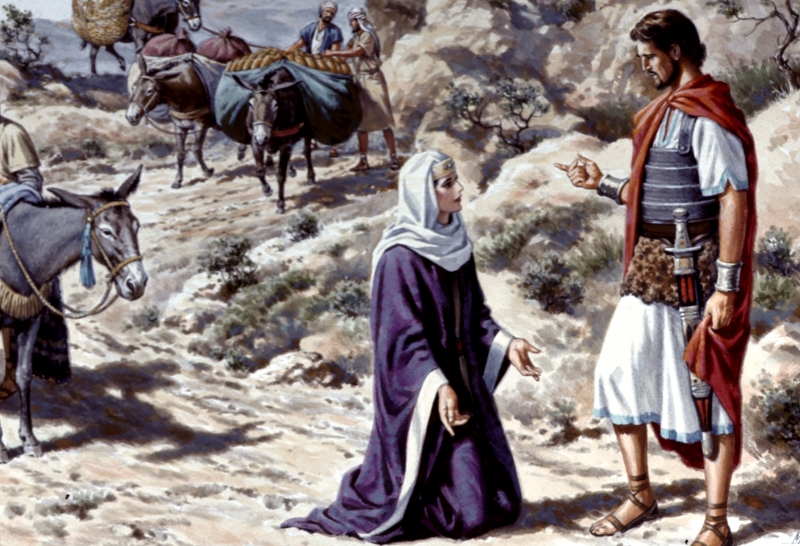
Abigail and David, Copyright:
V. Gilbert and Arlisle F. Beers

S: 1 Samuel 25:39 (New King James Version)
39 So when David heard that Nabal was dead, he said, "Blessed be the LORD, who has pleaded the cause of my reproach from the hand of Nabal, and has kept His servant from evil! For the LORD has returned the wickedness of Nabal on his own head." And David sent and proposed to Abigail, to take her as his wife.

O: David had gotten pretty ticked off at nabal's insults, and was all ready to get his own revenge when nabal's wife intervened. so he ended up letting nabal live, and within a couple of weeks, God took nabal's life.

A: how many times do i try to take matters into my own hands? this passage illustrates how God will fight our battles for us, if we will just simmer down and let Him, instead of going off half-cocked and doing it ourselves.

P: Thank you, Father, for being so willing to avenge us! so often i want to jump in and get even with people... and when i do, it usually doesn't turn out very well. and when i don't, i usually don't notice when you get even for me. i guess that's by your design... i'd probably get all big-headed about it if i did see.