Miles to go...

I have miles to go... please pray each day for the next leg of my Biblical journey!

Friday, July 27, 2012

Day 8: That Sweet Aroma!

 1897 Bible Pictures and What They Teach Us; Charles Foster
I know, I jumped out of place. This should be day 7, but I read the wrong chapters today! That's ok, tomorrow I'll go back and read what should have been read today. My blog entries will just be out of order.


Chewing through Leviticus has always been kinda hard for me. Today I read 15 chapters detailing the different offerings and all the ceremonial procedures for them. A lot of repetition. My eyes feel crossed and my brain hurts. And I still didn't understand the differences.


So I turned to the internet and looked up a few places that could explain them to me. I figured I could share that for today,. At least a summarized version.


  • The Burnt Offering: This was the most common offering, and the first mentioned in Leviticus. It was the only offering that could not be eaten, and it offered up that sweet aroma that the Lord found so pleasing. The burnt offering was voluntary, and symbolized total surrender to God.

  • The Grain Offering: This was also a voluntary offering, and the only one that did not require an animal sacrifice or shedding of blood. It was an offering of fine flour that offered up a sweet aroma to the Lord, symbolizing a living sacrifice.

  • The Peace Offering: This was also voluntary, and offered a sweet aroma to the Lord. It symbolized fellowship or communion, and was the only offering that the person who offered it could eat the meat of the sacrifice.

  • The Sin Offering: This was not voluntary, nor was the aroma pleasing to God. It was required as atonement for the sin nature in general.

  • The Trespass Offering: This was also not voluntary, and not a pleasing aroma to God. It was a required sacrifice to pay the penalty for specific sins one had committed.


i obtained this information from the following sermon outline.


Thursday, July 26, 2012

Day 6, "OMG"


by Kim Traynor, 2011, CC share-alike liecense *

Exodus 20:7

New King James Version (NKJV) 
7 “You shall not take the name of the Lord your God in vain, for the Lord will not hold him guiltless who takes His name in vain.


Or worded another way,

Exodus 20:7

New Living Translation (NLT)
7 “You must not misuse the name of the Lord your God. The Lord will not let you go unpunished if you misuse his name.

This really is such a pet peeve of mine that I struggled with using the common abbreviated text lingo in the title. Most people will agree that you shouldn't use God's name followed by the word "damn". And we all know that uttering the name of Jesus Christ as an expletive is wrong.

But how many people think absolutely nothing of saying "oh, my God!" as an exclamation, or texting "OMG"? I know many Christians, even, who take our Lord's name in vain in this manner every day, over and over, without even blinking an eye. I'm not trying to call anyone out, and I dearly love many of my brothers and sisters in Christ who do this, but it really is offensive. Not so much to me, as to God! He says that He won't give us a free pass for using His name in such a manner, and honestly, I don't want to see God punish anyone for something that most people would think trivial. It's not trivial to God.

So please, if you are guilty of this, please take note, and find a new way of expressing yourself.


Wednesday, July 25, 2012

Day 5: Dude, are you blind?


Exodus 10:7

New Living Translation (NLT)
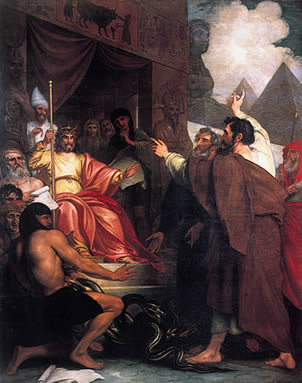
Moses & Aaron before Pharoah, by Benjamin West
7 Pharaoh’s officials now came to Pharaoh and appealed to him. “How long will you let this man hold us hostage? Let the men go to worship the Lord their God! Don’t you realize that Egypt lies in ruins?”

Moses and Aaron kept going to the Pharaoh, asking for the Israelites to be released to go worship God. Each time, Pharaoh refused, and God brought a plague upon the land. And with each plague, the king relented, and agreed to let them God if Moses would call God off. But Pharaoh was just so stubborn and hard of heart that as soon as God lifted each plague, he'd change his mind again.

So by now, the Egyptians had endured their water being turned to blood, they'd endured frogs, lice, and flies, they'd endured the death of all their livestock, nasty sores all over themselves and their animals, and a hail storm that had destroyed all the early harvest.

And now, they were facing yet another plague... locusts. We know them as grasshoppers. The grasshoppers were to destroy all remaining crops that were not yet ready for harvest... every blade of grass would be eaten, every piece of fruit, every leaf from every tree, nothing would be left.

Even Pharoah's servants could see that the king's stubborness was getting them into deeper and deeper trouble, and appealed to his better judgment... not that he had any, obviously, because he still refused, and more plagues came.

How often do we look at others who are so stubborn that they keep digging their own hole deeper? How many times do we want to tell someone we love "DUDE! Can't you see how you're making things worse?"

Better question... How many times have we been the stubborn fool, even when those around us tried to give us a reality check?

Tuesday, July 24, 2012

Day 4: Saving For A Rain-less Day


Genesis 41:34-36

New Living Translation (NLT)
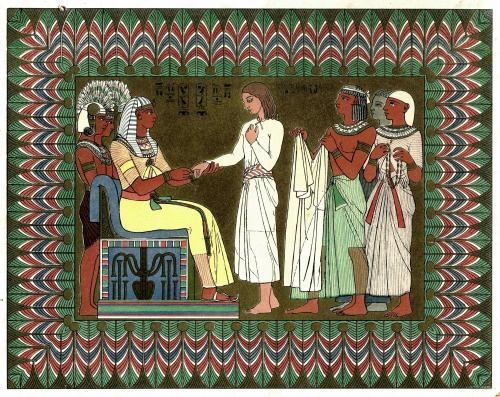
Pharaoh puts Joseph in charge, Owen Jones 1869
34 Then Pharaoh should appoint supervisors over the land and let them collect one-fifth of all the crops during the seven good years. 35 Have them gather all the food produced in the good years that are just ahead and bring it to Pharaoh’s storehouses. Store it away, and guard it so there will be food in the cities.36 That way there will be enough to eat when the seven years of famine come to the land of Egypt. Otherwise this famine will destroy the land.”

So, Pharaoh had a couple of nightmares and couldn't find anyone who was able to interperet them for him. That is, until the king's butler remembered about Joseph, living life in the dungeons, who had once interpreted his and the baker's dreams. So at the butler's recommendation, Pharaoh had Joseph brought up to him, and spilled his guts about his nightmares.

Joseph told the king that it was God who provides the dreams, and the interpretations, and that God was showing him that there would be 7 years of plenty followed by 7 years of famine. The reason he'd dreamed twice was God's assurance that it was going to begin very soon. 

Joseph encouraged Pharaoh to appoint a wise man to be ruler over the land, and officers to ensure that enough grain was set aside to prepare for the years of famine. Pharaoh was so grateful to know what his dreams meant, and for Josephs counsel about saving a portion of the harvest, that he decided to appoint Joseph as the ruler of the lands, second only to Pharaoh himself.

Most people have a savings account, or retirement fund. I wonder how many people set aside what Joseph had recommended? not 10%, but 20%. One fifth of everything. On our income, that seems like a lot. In fact, on our income, that would be impossible. It's a struggle to give God 10% at the beginning of each week. The thought of trying to live on a meager 70% is just incomprehensible. But I can't argue the wisdom! For 7 years, Egypt stored up 1/5 of all the grain harvested... and then for 7 more years, that 20% in storage fed not only the Egyptians, but people from all the surrounding nations who were affected by the famine, who had not set anything aside.

I have a friend who would insert the phrase here "that's God's economy!" And she would be right. When we are obedient with what God provides, He blesses it more abundantly than we ever could have imagined.

Monday, July 23, 2012

Day 3: The Cup Half Full

Dante's vision of Leah and Rachel, 1855

Genesis 29:32-35

New Living Translation (NLT)

32 So Leah became pregnant and gave birth to a son. She named him Reuben,[a] for she said, “TheLord has noticed my misery, and now my husband will love me.”33 She soon became pregnant again and gave birth to another son. She named him Simeon,[b]for she said, “The Lord heard that I was unloved and has given me another son.”34 Then she became pregnant a third time and gave birth to another son. She named him Levi,[c] for she said, “Surely this time my husband will feel affection for me, since I have given him three sons!”35 Once again Leah became pregnant and gave birth to another son. She named him Judah,[d] for she said, “Now I will praise the Lord!” And then she stopped having children.

I am so grateful that today's reading was the story of Jacob. I can never tire of reading about his life. I had a great deal of worry on my breakfast plate this morning, and had my reading been anything other than the story of Jacob, I may have been unable to focus. As it is, I am just now getting around to blogging about it.

There's so much in the story of Jacob I could post about. The amazing way God works to bring things into His will even when we act out of his will, (the deception regarding his brother's blessing), the unfairness of being suckered into marrying Rachel's sister first. Perhaps even more, the story of the mandrakes, and how Leah "purchased" Jacob for the night. Can you imagine how poor Jacob must have felt, coming home from the field, tired and dirty, only to see one of his wives running up to him telling him he had to perform sexual favors for her that night because she had bought him with some mandrakes?  And to think, people often think women were treated as chattel back then. Men weren't always treated any better!

But I decided to write about Leah's attitude, instead. Not the demanding attitude after the mandrakes, but the attitude of unfailing hope. She wasn't loved by Jacob. I suspect he resented her for more than one reason... He never wanted to marry her in the first place, then she's the one that keeps having kids, while the wife he loves is barren. Year after year, Leah kept giving birth to sons. And with each new bouncing baby boy, Leah came up with a name that expressed hope that this new child would be what would make her husband finally love her.

Of course, it never worked. He was good to her, but it was out of duty, not out of love. Still, she never gave up. And her hope wasn't placed in her son, it was always placed in God. Each new baby was a blessing from God, a gift to bring her joy, and a hope of loving affection.

As sad as it is, I have to admire her for that constant hope. She never gave up.


Sunday, July 22, 2012

Day 2: Duping The King


Genesis 20:2-3

New Living Translation (NLT)
2 Abraham introduced his wife, Sarah, by saying, “She is my sister.” So King Abimelech of Gerar sent for Sarah and had her brought to him at his palace.
3 But that night God came to Abimelech in a dream and told him, “You are a dead man, for that woman you have taken is already married!”


Genesis 26:5-10

New Living Translation (NLT)
Artist Raphael, circa 1518
5 I will do this because Abraham listened to me and obeyed all my requirements, commands, decrees, and instructions.” 6 So Isaac stayed in Gerar.
7 When the men who lived there asked Isaac about his wife, Rebekah, he said, “She is my sister.” He was afraid to say, “She is my wife.” He thought, “They will kill me to get her, because she is so beautiful.”8 But some time later, Abimelech, king of the Philistines, looked out his window and saw Isaac caressing Rebekah.

In a way, i gotta feel sorry for poor King Abimelech. And I have to shake my head in wonder at Abraham and Isaac! Two generations in a line of very godly men having a moment, so completely lacking in trust, that they would take their lives out of God's capable hands and tell such a whopping lie to save their own skins.

I have to feel sorriest for the wives... Imagine being told by your husband that you have to pretend not to be married, knowing full well that you are likely to be taken in marriage by someone else! That very nearly happened with Sarah.

Fortunately, God was watching over them in spite of their stupidity. But God was pretty harsh with Abimelech, even though he never consummated the relationship with Sarah. I wonder then, if 50 or 60 years later, he ever made the connection between Isaac and his father, when Isaac told the same lie?

It's a mighty gracious God we serve, who is willing to forgive our stupidity and watch over us even when we take matters into our own hands. We don't usually get a glimpse into how far reaching our sin can be, and how it impacts others. We see it here, though. Because of the lie told to him, Abimelech's whole household was destined to come to an end. God had struck all the women barren. If Abimelech hadn't restored her to Abraham, that would have been the last we heard of him... and it would have been through no fault of his own. No intentional fault, anyway. 

Saturday, July 21, 2012

Day 1: Innocence Lost


The first year I did this, i used the s.o.a.p. format to journal through. not this year. i'm going to be a little less structured in my note taking, and just write about what really stood out to me each day. of course, i may not always post an entry, because sometimes life gets in the way. this really is very time consuming. my typical routine is to wake up, turn on some praise and worship music on pandora and spend about 30 minutes waking up to God's grace, and then delve into the day's reading. you might ask how much reading that is every day, and the answer is roughly 12 pages. the official schedule is exactly 12, but i don't like stopping mid-chapter, so i tend to read on through a little further. if i don't stop to eat in the middle, it takes about an hour. there may be days that i will split the reading into a morning and evening portion. after i read, if time permits, i write my notes while it's still fresh in my mind.

Art by Wolfgang Sauber, used with permission
so let's get to it, shall we? i always read from my NKJV Bible, but i will often quote from other versions, such as below, i'm using the NLV for my notes. 

today i read the first 16 chapters of genesis. here's what struck me most...

Genesis 3:4-5, 16
New Living Translation (NLT)
4 “You won’t die!” the serpent replied to the woman. 5 “God knows that your eyes will be opened as soon as you eat it, and you will be like God, knowing both good and evil.”
New Living Translation (NLT)

16 Then [God] said to the woman,
“I will sharpen the pain of your pregnancy,    and in pain you will give birth.And you will desire to control your husband,    but he will rule over you.[a]”

Genesis 4:7, 13
New Living Translation (NLT)
7 You will be accepted if you do what is right. But if you refuse to do what is right, then watch out! Sin is crouching at the door, eager to control you. But you must subdue it and be its master.”

13 Cain replied to the Lord, “My punishment[a] is too great for me to bear!

The loss of innocense always begins with temptation. in eden, the serpant came and taunted eve, enticing her to eat of the fruit that God had forbidden to them. once she caved in and ate, (and sharing with adam), their spiritual eyes were opened and they were able to see right and wrong. as part of God's reaction to their disobedience, God told eve that she would from then on try to control her husband... but that the husband should rule over her. and in a godly marriage, that's still true today. the head of the house should be the husband... but oh, how we wives tend to want to be in control.

later, after eve's sons gave offerings to the Lord, cain got angry because his offering wasn't good enough. why was that? probably because cain only 'gave an offering of the fruits" and abel gave an offering of the first of the fruits. my guess is that cain gave God what was left over after he'd used what he wanted for other purposes. God doesn't like leftovers. 

so God asks cain why he's so glum, and reminds him that we're always going to be tempted. sin is always going to be there to taunt us, and to try and control us, but that we have to stand up and kick sin in the teeth and rule over our sinful nature. 

i added verse 13 just because it was the first biblical example of whining about the consequences. cain's response to God was pretty much "that's not fair!" of course it's fair! you screwed up... what do you want, a medal? how often do people break the laws and then want to lay the blame elsewhere. they don't want to face the punishment for their actions. they'll blame it on someone else, or on a crappy childhood even. but ya know, it doesn't matter how crappy our childhood is. we have choices. and when we make right choices, we sure do want the credit for making them! it's only fair that when we make wrong choices, we own them, too, no matter how hard the lesson is.